

BY: DAIRO SEYIFUNMI M. (BIGZION)

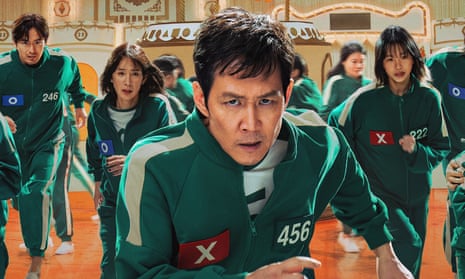
In Episode One (see here), we looked at how Squid Game mirrors Nigerian politics. How desperation shapes political choices, and why people often make decisions that seem irrational on the surface but are logical under pressure. In this episode, we’re going to go even deeper into how Squid Game mirrors Nigeria’s political space and explore possible solutions to it.
WHY WE ALL STAY IN A GAME WE HATE
In Squid Game, the players vote to leave the game. Yet, 83 percent choose to return.Then you’re forced to ask the question: Why return to something that almost got you killed? On the surface, that decision looks irrational.But when you dig deeper, you realise the answer is rational after all.
The hard truth is that leaving the game does not end the system. The game continues with or without you. If you leave, you return to debt, hunger, and uncertainty, while others stay and stand a chance to win. So it becomes simple: if you stay, you either win or lose. If you quit, you lose.
Even worse, even if you stay and win, the system does not disappear. The game continues. New players enter. The cycle repeats.This brings us to an uncomfortable truth. That is, winning inside a broken system does not fix it. And that is why the only real question is not how to survive the game, but how to stop it. Because if the system continues, it becomes a loop, just as we have experienced since independence. Vision 2010, vision 2020 never came to pass. Now it is 2026. New promises are already forming for 2030 and beyond. Yet nothing has changed. If anything has changed, it has been for the worse.
The cycle survives because we keep believing the next version will be different without changing the structure itself. We need to be honest: we are not just players in the game. We are trapped in its logic.
A practical example of this is the Nigerian voter. A voter may know a party is corrupt. But another calculation enters:”If I refuse to join them, I lose access. My community loses projects. The other party will still win, and they may punish us for not supporting them. So it is safer to stay inside the system than outside it.”
Individually, this feels rational. But when millions of people think this way, the outcome is quite predictable. Even a minority with money, structure, and coordination can dominate elections with far fewer votes. The result is then announced as a “mandate”, but in reality, it is often a mandate shaped by fear, survival, and fragmentation.This is where the deeper problem appears.
THE COLLECTIVE ACTION PROBLEM
What we are dealing with is not just corruption or bad leadership. It is a collective action problem. A situation where everyone would benefit if they acted together, but nobody trusts others to act first. So everyone stays stuck.You see this everywhere.
If you refuse to pay inflated electricity estimates alone, your light is disconnected while others continue paying. Nothing changes. If you alone reject vote buying, your decision does not cancel the system. You simply lose your share while others participate. If you refuse to pay police bribes, you are delayed while others pass. So next time, you pay too. If fuel prices increase, you complain, but still buy fuel because alternatives are limited. If school fees rise, you may protest, but others still pay because their education depends on it.
Even protests follow the same logic. Some people are paid to disrupt collective action, while others are too desperate to sustain it, and the movement gets weakened.
In every case, the system survives because the cost of being the first to resist is too high.So everyone stays in a game they hate.Not because they want it, but because leaving alone feels like suicide.
HOW TO TURN THINGS AROUND
Squid Game ends with Gi-hun surviving but psychologically broken. He wins the money, but the system maintains its hold over him.Nigeria often feels the same after elections: new faces, same pressures, same struggles.We lose because we keep playing by their rules: collect the money, defend “our own”, vote by tribe or emotion, and hope this version of failure will be better than the last.
To break the cycle, we must change the structure of participation itself.
1. Reduce desperation before Election Day
A voter with stability is harder to manipulate than one with empty hands. Economic insecurity is one of the most effective forms of political control.If empowerment only happens during campaigns, the system is already rigged. We need to build community-based economic support systems long before elections arrive.
2. Make honesty survivable
Right now, corruption is rewarded and honesty is punished. That signals to young people that integrity is a disadvantage. We must reverse that signal by supporting clean candidates, protecting whistleblowers, and creating consequences for political theft that are real and sustained.
3. Build trust at the grassroots level
One person rejecting vote buying changes nothing. But a community rejecting it changes everything. Change begins at the polling-unit level. Agreements must be local, visible, and socially enforceable.
4. Stop waiting for a saviour
No single leader can fix a system designed this way.Real change comes from organised citizens at every level who refuse to participate in the same script.
MEMENTO MORI: WE ONLY GET ONE TURN
The real question in the next election is not simply who wins. It is whether we will spend our one turn trading dignity for survival, exchanging one derica of rice or ₦5,000 for our votes, or begin dismantling the system that makes survival a political weapon.
Squid Game showed us the rules. Nigeria shows us the cost of ignoring them.The only question left is whether we continue playing or finally change the game.

