

By: Ogunleye Kolapo Olayemi

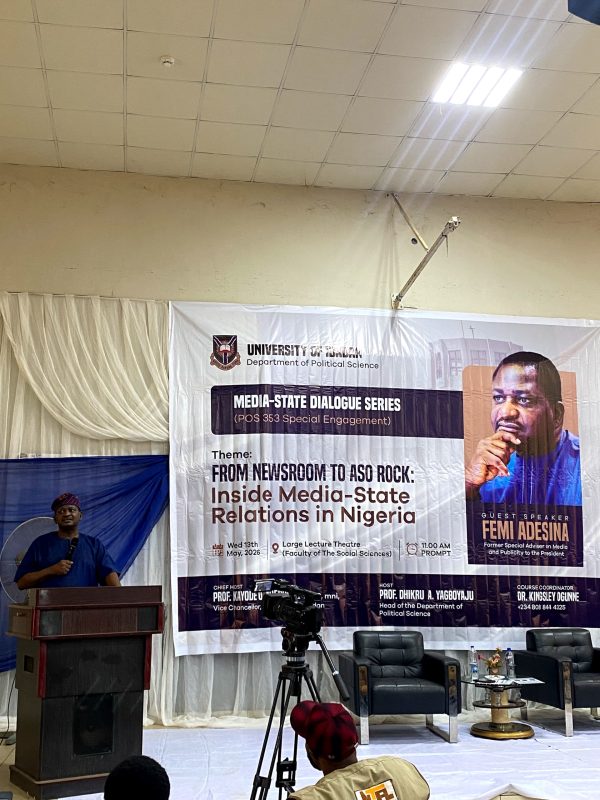
Former Special Adviser on Media and Publicity to ex-President Muhammadu Buhari, Femi Adesina, on Tuesday charged students of the University of Ibadan to build careers founded on integrity, professionalism, and credibility, warning that journalists who compromise their independence risk losing public trust.
Mr Adesina gave the charge while speaking at the maiden edition of the Department of Political Science’s Media–State Dialogue Series held at the Faculty of Social Sciences Large Lecture Theatre.
The event, organised for students of POS 353, “The Media and the State,” was themed “From Newsroom to Aso Rock: Inside Media–State Relations in Nigeria” and drew students, academics, and media practitioners from within and outside the university community.
Speaking during the engagement, Adesina stressed that reputation remains one of the most important assets in journalism and public communication.

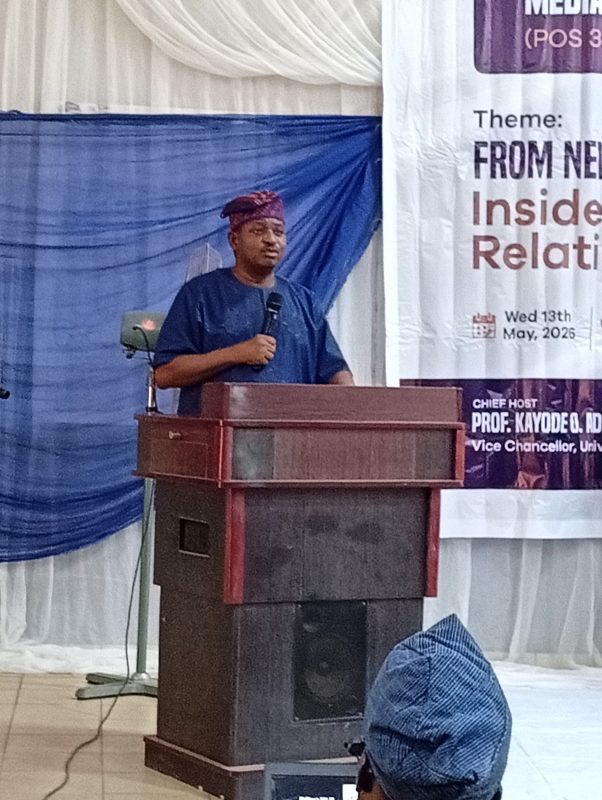
“As a journalist, you can’t be in bed with the government. If you do, you’ve lost it,” he said.
The former presidential spokesperson also urged young Nigerians to focus on excellence and competence rather than lobbying for opportunities, noting that his journey through journalism and government service was built on consistency and hard work.
“Be the best in whatever you are doing. There is no way the state will ignore you,” he said.
Recounting his career trajectory, Adesina explained how a newspaper column he wrote on former president, Muhammadu Buhari, eventually caught Buhari’s attention and marked the beginning of their relationship.
According to him, Buhari personally reached out to appreciate the detailed recollection contained in the article, after which both men became closer.
Adesina noted that despite serving as President of the Nigerian Guild of Editors, he initially had no interest in politics and never lobbied for government appointment before he was named Special Adviser on Media and Publicity in 2015.
Tracing his professional journey, the veteran journalist recounted working with Radio Lagos, Vanguard Newspapers, Concord, Tribune, and The Sun Newspapers, where he served as pioneer editor of Daily Sun before later becoming Managing Director and Editor-in-Chief.
Adesina also noted that 2026 marks his 40th year in journalism, adding that he was pleased to return to an academic environment to share experiences from both the newsroom and government.
While speaking Mr Adesina also distinguished between his role as an editor and his role as presidential spokesperson, explaining that while editors process information directly for public consumption, media advisers process information for dissemination through media organisations.
During the question-and-answer session, Adesina addressed concerns about his transition from scrutinising government as a journalist to becoming part of government. Responding, he stated that perspectives can evolve with better understanding and access to information.
“You believe what you believe, but if a better perspective is provided, one should not be dogmatic,” he said.
On the Freedom of Information Act, the former presidential aide argued that journalists must take greater advantage of the law.
“The law is there, but the media are not exploring it,” he added.
The Vice-Chancellor of the University of Ibadan, Prof. Kayode O. Adebowale, said the dialogue series reflects the institution’s commitment to connecting academic learning with practical governance realities.
Represented by the Head of the Department of Political Science, Prof. Dhikru A. Yagboyaju, the Vice-Chancellor described the programme as a “historic academic intervention” aimed at preparing students to engage critically with governance and political communication.
According to him, democracy can only thrive when both the media and government operate within a framework of responsibility, accountability, and mutual respect. “A functional democracy depends on a strong media and an accountable government,” the Vice-Chancellor stated.
Prof Adebowale further described POS 353 as more than a classroom course, noting that it exposes students to the evolving relationship between media and the state from the colonial era to the digital age.
In his remarks, Prof Yagboyaju, the HOD of the department commended Dr Kingsley Ogunne, lecturer in charge of POS 353, for conceiving the idea behind the dialogue series, adding that the initiative would become a recurring academic engagement within the department.
Among dignitaries present at the event were Prof. Emeritus Ayoade; Dean of the Faculty of the Social Sciences, Prof. Osayawe Benjamin Ehigie; Head of the Department of History, Prof. Àkànjí; Prof. Remi Aiyede; lecturers from departments including Law, Education, and History; as well as journalists from media organisations such as the Nigerian Television Authority (NTA), Credit fún, Guidance Newspapers and many others.
The event featured spoken word performances, drama presentations, and traditional Yoruba music and dance by students of the Department of Theatre Arts.

