

One week after a federal court ordered the reinstatement of three students punished for holding placards, UI’s student union has said nothing. Is the silence its verdict?

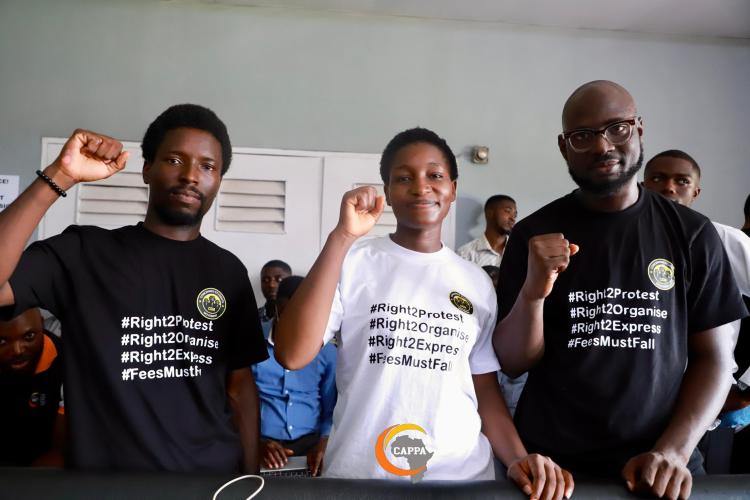
One week ago, on April 15, 2026, Justice Nkeonye Maha of the Federal High Court, Ibadan Division, delivered a judgment that should have shaken every wall in the University of Ibadan. Three students, Aduwo Ayodele, Gbadegesin Olamide Iyanuoluwa, and Linus Nice Adaomal had been dragged out of a hall, beaten, profiled as cultists, handed to soldiers, subjected to a disciplinary process rigged against them, and suspended for four semesters. Their crime: holding placards that read “Fees Must Fall” and “No To Fee Hike.”
The court set aside every sanction. It ordered their immediate reinstatement. It found that the university had violated their constitutional rights to fair hearing, freedom of thought, and freedom of expression. The judgment was, by any standard, a complete and decisive victory for students over institutional power.
Seven days have now passed. The University of Ibadan Students’ Union, the body that exists for no other reason than to speak when students cannot, to fight when students are punished has said nothing. Not one statement. Not one press release. Not one social media post. This silence is not an accident. It is a position.
What a Union Is For
To understand how catastrophically UI’SU has failed, you first need to understand what student unionism was created to do and why, at its founding, it was considered one of the most radical acts a young African could perform.
A student union, in its most foundational definition, is an association of students in a particular place of education, governed by rules and elected leadership, created primarily to protect and defend not only students’ interests but the entire society (Isah, 1991).
It is, as Zuokemefa and Sese described it in 2015, the system of practice and principle of labour unionism applied to an educational setting, the same logic that organised workers against exploitative employers, now organised students against institutional power.
The Collins English Dictionary puts it plainly: a students’ union is the organisation that organises leisure activities, provides welfare services, and represents students’ political interests.
The emphasis here is “political interests.” Not just end-of-session parties. Not just pageants or talent hunts. When students are dragged out of halls, beaten, handed to soldiers, and suspended for holding placards, that is, by every definition ever written, a students’ union matter. That is precisely, exactly, what a union exists for.
Where the Tradition Came From
This was not always a question that needed to be asked at the University of Ibadan. Student unionism in West Africa did not begin on a campus. It began in exile. In August 1925, twenty-one West African law students gathered in Camden Town, London, and founded the West African Students’ Union, WASU. They were led by a Nigerian from Abeokuta, Ladipo Solanke, and a Sierra Leonean doctor, Herbert Bankole-Bright. They came from different colonies, spoke different languages. What unified them was a single condition: that they were African in a city that regarded Africa as backward, inferior, and ripe for permanent subjugation.
WASU did not settle for just welfare. Within five years, it had persuaded a committee of Labour MPs to advocate for West African interests in Parliament. It published a journal, WASU Magazine, its name derived from the Yoruba word meaning“preach” that circulated across Europe and Africa. It campaigned against Italy’s invasion of Ethiopia in 1935. It took in Kwame Nkrumah, Jomo Kenyatta, and J.B. Danquah, men who would later dismantle British colonial rule across the continent.
In 1942, while Africans were dying in a European war fought under the banner of freedom, WASU demanded: you cannot ask us to die for a freedom you will not give us. It formally called for independence within five years of the war’s end.
WASU gave birth to the National Union of Nigerian Students in 1956, which gave birth to NANS in 1983. And the University of Ibadan was not merely present at the founding of this tradition. It was the founding itself. From the day the University College Ibadan opened its gates in 1948, the spirit of unionism had already been entrenched.
The Record UI’SU Built
What UI’SU did with that inheritance was remarkable. In 1962, UI students led a nationwide demonstration against the Anglo-Nigerian Defence Pact, a post-independence agreement that gave Britain unrestricted overflying rights over Nigerian airspace and obligated Nigeria to British military support. The students obtained a copy of the agreement, read it, understood exactly what sovereignty meant, and organised. Over a thousand of them marched on Parliament in Lagos on the day the Minister of Defence was presenting the terms. The protest was sustained, organised, and effective. The government abandoned the pact entirely. A student union forced a sovereign government to reverse foreign policy.
On February 1, 1971, a student named Kunle Adepeju was shot and killed by police during a demonstration at UI over the poor welfare conditions in Nnamdi Azikiwe Hall. His death did not silence the union. It hardened it. The Justice Kazeem Commission of Enquiry found the killing unjustified. Lawyers Gani Fawehinmi and Kanmi Osoba appeared pro bono for the students. Adepeju became Nigeria’s first student martyr, and the union’s building still carries his name today.
In 1978, UI students were among the first to respond when NUNS President Segun Okeowo sent word that a student, Akintunde Ojo, had been shot dead at the University of Lagos for protesting a 50-kobo increase in meal tickets. UI joined the nationwide confrontation that became the “Ali Must Go” crisis. Students across Nigeria faced soldiers, absorbed bullets, and refused to back down. The military shut universities, banned NUNS, and expelled Okeowo but they could not erase what the protests had demonstrated: that Nigerian students could mobilise across the country and force a reckoning with power.
These were not accidents of history. They were the product of a culture. A culture that understood student leadership as civic duty, that treated the university as a political institution, and that measured the worth of a union not by how many events it organised, but by whether it stood between its members and those who wished to harm them.
May 13, 2024: The Day Three Students Stood Alone
On May 13, 2024, during the inauguration of the previous administration led by Aweda at the Trenchard Hall, the same hall where generations of UI students had gathered to organise resistance, three students did what the union’s entire history demanded of them. They held placards. Non-violently. The placards read: “Fees Must Fall.” “No To Fee Hike.”
The context was not trivial. The University of Ibadan had approved a fee increase that took tuition from about ₦30,000 to between ₦203,000 and ₦412,000. For a student whose parents had stretched every resource to fund a university education at what was supposed to be Nigeria’s premier public institution, that increase was a crushing blow.
The three students: Aduwo Ayodele, a 400-level History student; Gbadegesin Olamide Iyanuoluwa, a postgraduate student at the Institute of African Studies; and Linus Nice Adaoma, a 400-level Law student, did not cause a scene. They only held placards. The university’s security dragged them from the hall and handed them to what the court later described as “a waiting mob” that beat them. They were then profiled as suspected cultists and handed to soldiers of Operation Burst, a joint military-police security force. They were taken to a military facility in Agodi, Ibadan, before eventually being released after the soldiers expressed surprise at the situation.
Then came the bureaucratic punishment. On July 2, 2024, they were summoned before the Students’ Disciplinary Committee. The committee found two of them, Ayodele and Gbadegesin guilty of misconduct. On July 14, 2025, the Central Student Disciplinary Committee, rusticated them for four semesters. Two full academic years, barred them from Student Union activities, and required them to sign undertakings of good behaviour and undergo mandatory counselling.
Nice Linus, the third student, faced a different but equally brazen victimisation: the university refused to inaugurate her as a member of the Students’ Representative Council despite her having won a free and fair election.
In September 2025, the three students, with no institutional backing, no union support, only their lawyers and their convictions filed a fundamental rights enforcement suit at the Federal High Court, Ibadan. They challenged the suspension as a violation of Section 36 (right to fair hearing), Section 38 (freedom of thought), and Section 39 (freedom of expression) of the 1999 Constitution. On April 15, 2026, Justice Nkeonye Maha ruled entirely in their favour. She set aside every sanction. She found the disciplinary proceedings fundamentally flawed. She noted there was no evidence their protest had disrupted anything. She ordered their immediate reinstatement and the restoration of their full studentship from May 13, 2024.
The UI3s had gone to court. They had fought alone. And they had won.
The Silence That Damns
Seven days later, the University has remained silent. That is quite expected. What is not expected, what is, by any honest measure, inexcusable is the silence of the University of Ibadan Students’ Union. In the weeks since the judgment, the current UI’SU executive, led by Adeboye Temidayo, has issued no statement demanding the university comply. It has held no press conference. It has organised no demonstration. It has not visited the UI3s. It has not published their names. It has not told the student body what happened or what is being done about it.
The union that once forced a British defence pact off the table. The union whose building is named after a student who died so it could stand. That union has looked at three of its own members, beaten, profiled as cultists, and suspended for holding placards at a union event, and said absolutely nothing.
How the Mighty Fell
This did not happen overnight. The degradation of student unionism at the University of Ibadan and across Nigeria is a long story with identifiable chapters. It began in earnest with the military. The series of crackdowns between 1978 and the 1990s did not merely ban unions temporarily. They targeted the ideological foundations of the movement. Activists across campuses were rusticated, expelled, and detained. The replacement of NUNS with NANS in 1983 came with its cost: something in the reconstitution was lost.
NANS, once the most feared student body in the country became the prize politicians competed to control. By the 2010s, it was no longer unusual to find NANS leaders in their forties, embedded in political party structures, deploying the union’s machinery for ballot-season mobilisation and returning to silence immediately after. The union had become a tool for politicians.
When the University of Ibadan announced the fee hike that drove students to protest in May 2024, UI’SU under the Aweda led administration did not resist it. It endorsed NELFUND, the federal government’s student loan scheme and encouraged students to take loans rather than fighting the fee increase itself. In doing so, the union that once rejected the Anglo-Nigerian Defence Pact as an affront to sovereignty accepted the commercial logic of fee hikes as an inevitable reality to be managed, not a policy to be reversed.
When three students took the direct action that the union’s entire history demanded, the union did not stand with them. It did not even acknowledge them publicly. When they were beaten and handed to soldiers, the union said nothing. When they were suspended, the union said nothing. When they went to court alone, the union said nothing. When they won, the union said nothing. The Kunle Adepeju whose name is on the union’s building died because students fought for welfare and the state shot back.
The current union watched three students fight the same battle and couldn’t be bothered to tweet.
A Failure of Mandate
What the UI3 case reveals is not merely a union that failed one moment. It reveals a union that has fundamentally misunderstood, or deliberately abandoned its purpose. The UI’SU constitution declares that the union shall “draw attention at all times and in all places to any form of exploitation, discrimination, oppression and any other social vices among students.” This is not optional. It is constitutional. When three students are unconstitutionally suspended for protesting a fee hike, that is suppression. That is precisely the mandate the union exists to confront.
Instead, the past and the current executive led by Adeboye Temidayo and his cabinet has spent the year presiding over a union that is more comfortable hosting forums than filing motions, more adept at releasing vox pop than demanding compliance with court orders.
What This Moment Demands
CAPPA, the Corporate Accountability and Public Participation Africa, put it plainly in the wake of the judgment: “The court’s decision sends an unequivocal message to the University of Ibadan and other oppressive academic institutions nationwide that tyranny and the use of authoritarian tactics to stifle legitimate dissent is unlawful, unacceptable and will not stand.”That message was addressed to the institution. But it applies equally to the union. Student unionism was not built by people who waited for safe moments. It was built by Ladipo Solanke fundraising across colonial West Africa for a student hostel.
By UI students marching on Parliament in Lagos in 1962. By Kunle Adepeju, whose last act was to stand in a protest whose legitimacy no one disputed. By Segun Okeowo, who was expelled from his own university for refusing to watch a government shoot students into silence.
The UI3s showed, in 2024 and 2025 and 2026, that the tradition is not dead. It lives in three students who held placards, were beaten and profiled as criminals, and responded not by backing down, but by going to court. Who fought for nearly two years without institutional support. Who won.
The question is what the union will do now that they have won. It is not enough to stay silent after a judgment and call it diplomacy. It is not enough to hold forums or symposiums about the meaning of unionism while three reinstated students are still being ignored. It is not enough to invoke the legacy of Kunle Adepeju in anniversary commemorations and then abandon the next generation of students who carry that same spirit.
The union owes Aduwo Ayodele, Gbadegesin Olamide, and Linus Nice Adaoma a public statement of solidarity today, not next week. It owes the student body a demand, in writing and in public, for the university’s immediate, full, and unconditional compliance with Justice Maha’s order. And if it cannot do these things, it owes the 30,000 students of the University of Ibadan the honesty of saying so of admitting that the tradition of 1925, 1962, 1971, and 1978 has been reduced, under the current administration, to a body that organises events, manages a building, and watches in silence when its own members suffer.
The union’s building is named after a student who died for it. The least it can do is speak.

