
By: Dairo Seyifunmi [BIGZION]
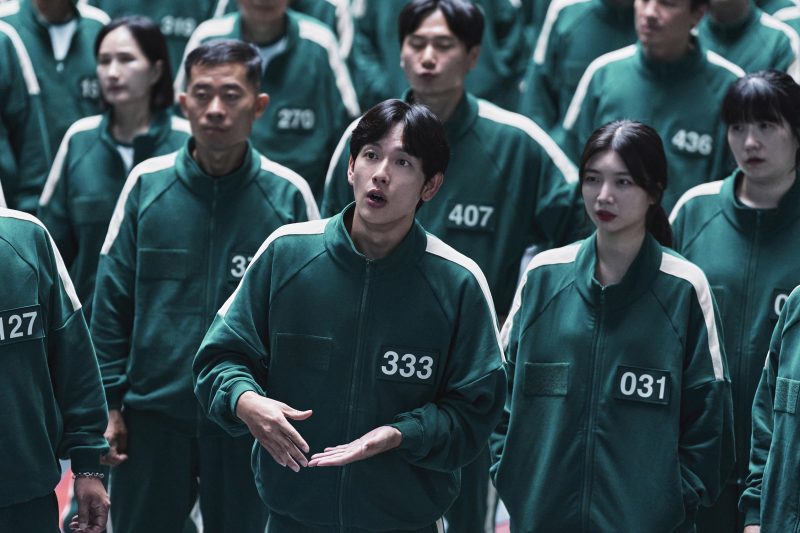
If someone offered you a 1-in-456 chance to win ₦45.6 billion, but told you you might die trying, your answer would likely be a simple: NO. Why? Because it’s simply not worth it. But what if you change the conditions? Let’s say you’re drowning in ₦500,000 debt. Your mother needs urgent dialysis. Loan sharks already know your house. Suddenly, the question is no longer “Is this worth it?” It becomes “What’s the first game?” This is the logic behind Squid Game. And it is the same logic that drives Nigerian politics.
At first glance, Squid Game looks like a story about extreme choices. But when you look deeper, it is a story about systems that leave people with no good options. It shows what happens when survival replaces freedom as the basis for decision-making. That is where the connection to Nigeria becomes even more clear. Nigerian politicians have, over time, weaponised poverty in deeply strategic ways.
The same political class that presides over economic hardship returns during elections with packaged gaari Ijebu, rice, Ankara, and ₦5,000, to present temporary relief as generosity. And people unfortunately collect it. This is not because they are ignorant. Not because they lack values. But because, in that moment, survival matters more than long-term consequences. This is in no way an irrational behaviour. It is a predictable response to pressure.
Even visually, the symbolism is hard to miss. The players are dressed in green and white colours that mirror Nigeria’s national identity. Whether intentional or not, it reinforces the central idea: a collective of people bound together, navigating a system designed to test survival rather than reward fairness. It is not just an individual struggle. It is systemic.
Desperation Makes Bad Bets Look Rational
Every player in Squid Game made a choice to participate. No one was physically forced into the arena. But their reality tells a different story. They were choosing between prison, starvation, crushing debt, or violent threats. When one look at it from this context, you realise choosing to play the game was in fact the least terrible option on the table.
The same pattern plays out during elections in Nigeria. No voter genuinely desires bad governance. Nobody hopes for unpaid salaries, poor infrastructure, insecurity or failing institutions. But when elections come, the choices rarely feel meaningful. One party distributes rice. Another offers small cash. With the real life issues and struggles people face daily, in that moment, voting stops being about policy or ideology. It becomes more about immediate survival. So the rice is collected. The money is taken. Not because the future does not matter, but because the present is what matters.
This is where many critiques of voters miss the point. They assume poor decisions come from poor thinking. In reality, they come from constrained options. Political science explains this through the idea of bounded rationality: people make decisions within the limits of what is available to them. When the available choices are all flawed, even a bad decision can be logical. The real issue, then, is not the voter. It is the structure that keeps voters desperate enough for short-term relief to outweigh long-term judgment.
“You Consented” Isn’t Freedom
One of the most disturbing ideas in Squid Game is the insistence that every player agreed to participate.“You signed. You agreed.” Technically, that is correct. But when the alternative is hunger, violence, or ruin, consent becomes questionable. Choice exists, but freedom does not.
A similar argument appears in Nigerian politics: “Nobody forced you to collect money at the rally.” Again, technically true. But reality is more complex. If every major political party offers incentives, and you are unemployed or struggling, refusing does not change the system. It does not alter the election outcome. It only means you go home empty-handed while others benefit. So people participate. They collect. They justify it in small ways: “At least this one is our own.”
This is not simply voter weakness. It is what political scientists describe as coercive patronage. Support is no longer built on ideology or policy. It is built on exchange. Immediate needs are traded for political loyalty. Poverty becomes a tool, organised and deployed during elections. And the cycle sustains itself. Leaders emerge from this system and fail to improve conditions. Poverty deepens.
By the next election, the same tactics work again, often even more effectively. Like Squid Game, the system is designed to continue.
To be continued….
