
By: Ogunleye Kolapo Olayemi
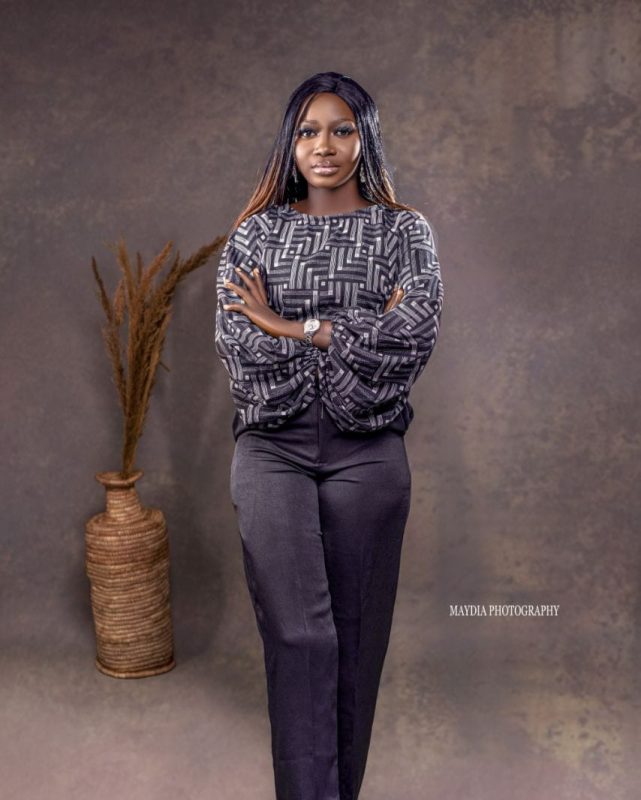
In this interview, Adekola Rihanat Ololade, former Editor-in-Chief of POSSPRESS and a first-class graduate of Political Science, shares her journey through campus journalism, academic excellence, and leadership at the University of Ibadan. She reflects on discipline, writing, faith, and the lessons that shaped her undergraduate experience.
POSSPRESS: Kindly introduce yourself.
Rihanat: Hello, I’m Adekola Rihanat Ololade.
Campus Journalism Journey
POSSPRESS: What motivated you to join campus journalism?
Rihanat: The quest to write more and to unleash what I believe I’m good at.
POSSPRESS: Are there any journalists you particularly admire or look up to?
Rihanat: Yeah, a lot. Fisayo Soyombo, Abdulrahman Adebayo, Eriomala John
POSSPRESS: In what ways has your involvement in campus journalism shaped you academically and personally?
Rihanat: A lot, I can’t even mention all. Academically, it has really shaped the way I write, which has saved me countless times during exams and tests owing to the volume of writing political science exams requires. Personally, journalism has built my courage and strength and shaped my leadership behavior.
POSSPRESS: Why do you think student politicians see the press as adversaries?
Rihanat: I believe only those who are allergic to the truth see the press as adversaries.
POSSPRESS: As EiC, what was your most fulfilling moment?
Rihanat: My most fulfilling moment as Editor-in-Chief of POSSPRESS was sustaining the tradition of POSSPRESS and, to some reasonable extent, elevating it. The end results were excellent and fulfilling. I received good feedback on the Billy Dudley Symposium from both speakers and audience.
POSSPRESS: Leadership often comes with pressure. What was your toughest moment, and how did you navigate it?
Rihanat: My toughest moment was writing my final year CAs the same week we were to hold the Billy Dudley Symposium. How did I navigate it? I don’t know. But the end result was excellent.
POSSPRESS: How would you describe your experience leading POSSPRESS?
Rihanat: It came with a lot of pressure. It was worthwhile. It made me stretch myself in ways I never thought I could. I’m glad I did.
POSSPRESS: How did you balance being EiC with maintaining a first-class academic performance?
Rihanat: From the moment I was appointed Editor-in-Chief, I prepared my mind to excel in both paths. That mindset kept me going until the end.
POSSPRESS: What advice would you give to current POSSPRESS members?
Rihanat: Just be you. Campus journalism comes with a lot of pressure. The person you never thought would criticize you might be the one leading the criticism. Stay true to journalism principles and do not bend the rules for anyone. I wish you all the best.
POSSPRESS: Do you see yourself pursuing journalism as a long-term career?
Rihanat: Yeah, I do.
Academic Excellence Journey
POSSPRESS: Were you always on a first-class trajectory from 100 level?
Rihanat: Yes, I was on a first-class trajectory from 100 level until graduation.
POSSPRESS: How did you maintain it?
Rihanat: How I maintained it is a story I can’t tell without acknowledging Allah. Alhamdulilah, the end product was praiseworthy.
POSSPRESS: What specific study methods worked best for you?
Rihanat: Different methods worked depending on the course: MTN (Morning Till Night)TDB, Remontada, Ejaculatory reading
POSSPRESS: Could you explain MTN and ejaculatory reading?
Rihanat: MTN means Morning Till Night. Ejaculatory reading means reading at any slight opportunity, even while eating or during random activities.
POSSPRESS: Were there moments you felt overwhelmed? How did you handle them?
Rihanat: Yes, a lot. Whenever I felt overwhelmed, my go-to remedy was Tahajjud prayer in Islam.
POSSPRESS: How did you approach essay-based exams?
Rihanat: I love note writing. It helps me coordinate my thoughts and improves understanding and recall during exams. During exams, I write outlines of how I intend to answer questions. I also choose topics based on predictions, though not all predictions can be trusted. My journalism experience helped a lot.
POSSPRESS: Which level was most challenging, and why?
Rihanat: 400 level was the most challenging due to extracurricular activities and my final year project.
POSSPRESS: What habits contributed most to your academic success?
Rihanat: Note-taking in class and extensive reading. Also, strong continuous assessment performance is very important in social sciences courses.
POSSPRESS: What is the biggest trap students fall into, especially those who aspire first-class?
Rihanat: Poor continuous assessment performance. It can reduce the chances of getting an A in a course.
POSSPRESS: What career path are you looking forward to?
Rihanat: Policy and Governance.
POSSPRESS: What is one misconception people have about student journalists?
Rihanat: They think campus journalists are generally wicked.
Politics and Closing
POSSPRESS: Assessment of the Iran–Israel–US conflict. Was it inevitable or avoidable?
Rihanat: It is inevitable. Samuel P. Huntington, in his work “Class of Civilisation, 1996” predicted that two cultures are likely to continuously clash, which is the Western civilization and the islamic civilization. Despite the claim that prediction is very poor in political science, this claim stood out. The 9/11 attack is an example. I believe the ongoing attack is also an example too.
POSSPRESS: What are your thoughts on Nigeria returning to regionalism? Does decentralisation help?
Rihanat: Can we return to regionalism? Yes. Do we have to? No. Even in a region, internal divisions will still exist.
POSSPRESS: Who do you consider the most impactful theorist during your undergraduate studies? And Which theory had the most significant influence on your worldview?
Rihanat: There are a lot of theories. I believe rational choice theory is the most impactful. The one that has significantly influenced my worldview is social constructivism theory by Alexander Wendt and Nicholas Onuf.
POSSPRESS: What is your fondest memory of the University of Ibadan?
Rihanat: The Dean’s Roll of Honour Awards.
POSSPRESS: What advice would you give to 100-level students who aspire to graduate with a first class?
Rihanat: Do what works for you. Don’t follow a multitude. However, judge what you’re doing with the multitude to know if you’re still on the right track. Meet up with those who have more experience than you do. Knowing what your lecturer wants and how to put it down matters too.
Like the saying goes, “follow who know road.” Ask questions. No senior will come to you in the comfort of your room to tutor you on how to write your test or exams.
POSSPRESS: Thank you so much for your time. I truly appreciate it and wish you all the best.
