
By Ogunleye Kolapo Olayemi
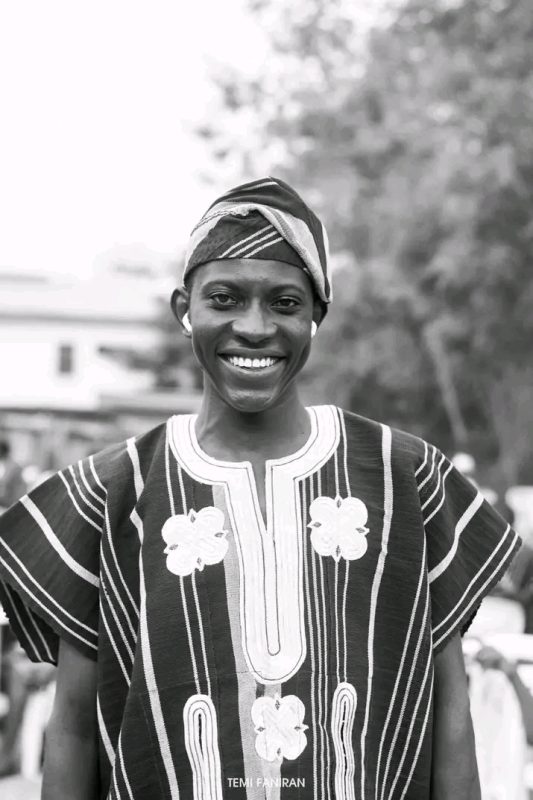
In this interview, POSSPress chats with the immediate past president of NAPSS, University of Ibadan, Adeoti Mubarak Adebare, to talk about his first class feat, student politics, youth inclusion, governance, what it really takes to lead, and of course his football GOAT.
Adeoti Mubarak Adebare needs no introduction to most Political Science students at the University of Ibadan. He served as President of the National Association of Political Science Students (NAPSS), UI chapter, for the 2024/2025 session, graduated with a first class degree, and is currently serving as a corps member. In this interview, he opens up about his university journey, his time in office, and his views on youth inclusion, governance, and Nigeria’s future.
Let’s start simple. Who is Adebare? Walk us through who you are in a few sentences. What are your passions, what do you love, what do you dislike, and what makes you who you are?
Good evening, Mr Press Man. I am Mubarak Adebare Adeoti, a young advocate of good governance, youth inclusion, and nation building. I believe strongly in effective public policy, not just within our borders but across global systems. I love football, public policy development, and pushing for change with excellence. I dislike laziness. Some of the things that shaped me are a habit of dreaming beyond borders, a love for excellence, and a passion for changing narratives through innovation and collaboration. I also love proffering solutions to problems.
I believe in the power of compounding over time, because success is not a product of overnight effort but a product of consistency. I am still a work in progress. I have not attained my peak. I am just striving to do what I can.
Take us back to your first semester at UI. What was it like? Any funny memories?
That was the 2021/2022 session. It was interesting. As a fresher, I already had my plans set before the session was disrupted by an eight month strike. That strike had a lot of effects on us and was a turning point for many students. Everybody has their priorities. I knew mine, and our contemporaries knew theirs too.
Looking back, how did the eight month strike affect you as an individual?
It came with a mix of advantages and disadvantages. I went back into my printing design work and secured more clients for the brand I was running then. I also used the time to strengthen youth advocacy by establishing African Young Minds, a socio-political organisation focused on youth inclusion. I read a lot during that period and reflected deeply on leadership, youth development, and how Africa’s development as a continent can be sustained.
One of my favourite quotes captures it best: “If you can conquer your locality, you will become an exportable material for the global sphere.” Africa needs new breeds and dimensions of leadership. Young people must be ready to create value in achieving that. We should not act our age, but our capabilities and competence, because the age of Methuselah has nothing to do with the wisdom of Solomon.
You mentioned youth inclusion as one of your major passions. What does genuine youth inclusion look like to you, and are Nigerian youths actually being included in decision-making?
Youth inclusion means having young people in key, reputable positions across all levels, whether in politics, professional fields, or the public sector. Nation building should not be about age stratification. It should be about including diverse people regardless of age, social status, or wealth. Over the last few years, many youths given the chance have shown what they can offer, from business to tech, politics, health, law, and beyond. I have seen transformation. But it starts with anyone given the chance to showcase leadership through ethical orientation and strong conviction. We must be good ambassadors.
Very few Nigerian youths show genuine interest in governance. What can be done to draw in the best and brightest, so the worst don’t end up representing us the way the current crop does?
Youth inclusion does not mean everyone must go into governance. It means young people should become leading figures in whatever field they choose. Take journalism, for instance. Akintunde Babatunde was appointed programme coordinator of the Centre for Journalism, Innovation and Development at just 29. Professor Aina was appointed Registrar of JAMB at 39. These are impressive examples. It starts with our own readiness to make a difference. We need prepared youths who are ready to serve and lead before they are even called.
Was there a particular experience that made you realise governance and public policy were areas you wanted to devote yourself to?
Governance and public policy touch every part of life. When government puts good policies in place, it reflects positively on the generality of the masses. That is why public policy is critical. It is the heart of national development. It can make or mar a nation.
Do you think Nigeria’s problem is a lack of good policies, or a lack of will to implement the ones already on ground?
Public policy is most effective when government studies the ecology, weighs the pros and cons, and considers the prospects of a policy before implementing it. Communication also matters in governance, and I am glad many states now have feedback mechanisms in place. We can borrow from global models of administration to solve our own problems here, through citizen engagement before implementation. That is what new models like Digital Era Governance and Public Values Governance preach.
Let’s go back to your university experience. What’s one memory from your first year that still makes you laugh?
If my memory serves me right, it has to be Zik Hall in the evenings. The Aro, Ewa Night, the evening gyrations. Those are fantastic memories. Zik Hall will always be my home.
Resuming school after the eight month strike, what was the biggest adjustment you had to make as a returning student?
I jotted down my goals, analysed my strengths and weaknesses, and set my priorities. We resumed around 22 October 2022, and to God be the glory, I was able to meet a huge proportion of those expectations.
Was first class the goal from the onset, or did you realise it was achievable after your first year?
It came from a passion for excellence. I did not know much about first class grades until I got to campus. But I met seniors like Adebayo AbdulRahman, Elesho Ayotomiwa, Victor Johnson, Benjamin, then NAPSS president Ikotun Samson, and then NAPSS vice president Etuk Faith. We were all at a conference together around January 2022, and I was motivated by how they approached things. I told myself, if these people can do well, I can too. I also drew motivation from the success stories of past Zikites, from leadership to academic excellence. I learnt a lot from Ayantola Maximus, a former Student Union PRO from the 2015/2016 set, and Akeju Oluwasegun, now a barrister, who made first class despite being Student Union President and scored above 3.8 out of 4.0 in Mathematics. All of them were Zikites, and it taught me that the journey to global relevance is not a walk in the park. Always strive for excellence and never listen to naysayers who tell you it cannot be done.
Being first class in Political Science is not a walk in the park. Walk us through your actual study routine, not the generic “I read hard” answer.
(laughs) I won’t give out all my secrets, but it goes beyond reading and being prayerful. To succeed in Political Science, you have to stay conversant with current affairs, polish your writing skills, and read policy papers and reports. One thing that set me apart was that between my 200 level second semester holiday and my 300 level first semester, I read 25 inaugural lecture papers. That strengthened my ability to harness new knowledge, interrogate existing ideas, and gain fresh insight. An inaugural lecture is itself a discovery, a channel for an academic to preach from an academic pulpit, the way pastors and imams do in churches and mosques.
Many students believe first class requires sacrificing everything outside academics. Do you agree, or is balance possible?
I was able to balance it with the other things I was doing. It did not affect me at all. In fact, I still feel I could have done even more.
Some students still struggle to strike that balance. What’s your advice to them?
Time management is key, and they need to strengthen themselves internally. I faced a lot in my final year, balancing academics with administrative duties and my long essay. It is about your ability to stretch yourself. Some nights I was handling administrative work until 3am, but I still had to stay focused on academics.
How did you prepare for examinations? Walk us through your reading secrets.
I make notes ahead of time, structure how I plan to answer questions, and at the end of it all, I pray. That’s it. I am not a genius.
Do you think the Nigerian university system adequately rewards genuine academic excellence? How can this improve?
Honestly, the reward system has not been encouraging, but we need a different approach to tackle it.
- We need stronger alumni relations.
- We need skills-driven tertiary institutions. Universities should not just issue certificates but create an ecosystem where students gain skills that make them useful assets. It is not only about class of degree. Many skills exist out there that even Political Science students are unaware of.
- We need stronger public-private partnerships with our universities. Many public-spirited individuals are willing to donate towards celebrating academic excellence.
UI is often called Nigeria’s Ivy League, yet there’s little collaboration with multinational companies, unlike Ivy League universities elsewhere. IITA, for instance, sits in Ibadan, yet has no notable research presence on campus. Why do you think this is?
Higher institutions in Nigeria face a lot of challenges rooted in budgetary allocation and paucity of funding. Are we even adhering to UNESCO’s recommendations on education funding? Simply, no. Nigerian universities are not what they used to be in terms of research and grants. We need more collaboration, and that is why the presence of foundations like the MacArthur Foundation, MasterCard Foundation, and the European Union matters. They assist with research funding and exchange mobility programmes that allow Nigerian students to study abroad.
We need to strengthen our institutions through funding, and we can also leverage bodies like NITDA, the Nigerian Communications Commission, and the Ministry of Communications, Innovation and Digital Economy to support ICT development in universities. Professor Saheed Aderinto, a Nigerian professor based in the US, once pointed out that university lecturers abroad are entitled to a work laptop, which is rarely the case in Nigeria. We can do better. Research institutes and policy think tanks are another lever we can pull to strengthen our universities. There is a lot to unlock if we get this right.
Now to your presidency. Take us back to before you became NAPSS president. Why did you decide to contest?
My decision was not born out of selfish interest but a desire to serve and take our association to the next level. Before contesting for NAPSS, I had held leadership roles from the departmental level to my hall of residence and the Student Representative Council. I had served on committees, written policy briefs, and sponsored bills. I knew what administration entailed. Some people doubted I would win, and some said I was egoistic and entitled. None of that was true. I never dreamt of being NAPSS Senate President. In fact, my hall of residence stakeholders wanted me to return to UI SRC for a second term as a high-ranking member. For the 2023/2024 session, I was one of the most active and influential SRC members throughout our parliamentary sessions.
Was there any decision you made in office that you’d defend without apology, even if it was unpopular?
Absolutely none.
Disagreements are inevitable in leadership. Was there a time your executive clashed with the legislative arm, and if so, how did you handle it?
Throughout our administration, we made progress without any major fights. I would say it was one of the best administrations, if not the best, in terms of collaboration with other organs. The Senate President, the Editor-in-Chief, and the Learning and Development arm, we always deliberated together. When accountability and transparency were called for, I delivered. Power corrupts, and absolute power corrupts absolutely. We made progress by going to the Head of Department’s office together to iron things out.
Looking back, what would you tag as your biggest achievement as NAPSS president?
There are many. If you serve well, your legacy becomes a trail for those who come after you. Under our administration, the Political Science department’s ranking moved up into the top three departments in UI, based on performance, though the organisers of the award had their own interests. Some other achievements include:
- Introduction of the Freshers’ Essay Writing Competition, later renamed the Professor Irene Pogoson Memorial Essay Competition
- Launch of the Meet a Mentor Series
- Project Writing Workshop and Seminars
- Purchase of a public address system for the department
- Partnership with SRC and Twelve Eleven to organise a Model National Assembly
- Hosting the Southwest Regional Convention in Ibadan for three days
- Setting up the NAPSS Global Resource Centre
- Introduction of an internship proposal for NAPSS members
I am glad the present administration is following in those steps. It shows we did well. Most of these projects were funded through sponsorship. No money was withdrawn from the association, not even for the public address system and projector we got for the department.
What’s your read on UI student unionism right now? Do you think it still exists in this university?
I can’t really say, since I am no longer at the University of Ibadan. Student union politics differs from institution to institution, and UI has its own dynamics.
Having experienced politics at the student level, what similarities do you see between student politics and Nigerian politics?
They are different. Student politics is just a preparatory ground. It is nothing like the gladiatorial politics out there.
What is one area where you think Oyo State needs serious improvement?
Nobody is perfect, because governance is never easy. Oyo State has done commendably well over the years in terms of infrastructure and legacy projects. The state came third this year in Value Added Tax generation, after Lagos and Rivers, despite not being an oil-producing or heavily industrial state. That is commendable. Roads across zones outside Ibadan, like Moniya to Iseyin, Ogbomosho, Oyo, and Saki, have been constructed. We need local government administration to do more, especially with inner road construction. On tourism, Oyo State can borrow from Ekiti State’s public-private partnership model used at Ikogosi Warm Springs. We have attractions like Iyake Suspended Lake, Oke Ebedi, Iya Mapo, Kap Film Village, and Ẹfín Chàttà. The state has a good ecosystem for business to thrive in too.
Do you think Nigeria’s biggest problem is bad leadership, weak institutions, or citizens’ attitudes?
Change starts with everyone. The micro environment is a miniature of what plays out in the macro environment. We must see ourselves as leaders before we even have a constituency. Conviction matters a lot in whatever we do.
You went from NAPSS president and first-class graduate to corps member. How different has this phase been?
It is a continuation of the learning phase. I stayed actively involved in leadership at camp too, serving as my platoon’s assistant leader. Leadership is about commitment to serve and showing empathy for others. Advancing other people’s interests has always been my priority, not chasing titles, as many would assume.
Has NYSC changed your perception of Nigeria or Nigerians in any way?
No. I have always been a patriot and a strong believer in Pan-Nigerian unity. NYSC has only strengthened my commitment to do more for Nigeria as a country.
What’s your take on the proposed NYSC reforms by the Federal Government? From your experience as a corps member, what aspects of the programme genuinely need reform?
NYSC as a scheme needs innovation, especially a shift towards a digital-driven approach rather than still relying on paper-based administration. The Skills Hub also needs to be strengthened, to empower corps members with 21st century skills.
After NYSC, what does the next chapter look like for Adebare? Further education, career development, entrepreneurship, public service, or something else?
Plans are ongoing. Until then, the next step will unfold in order.
If you weren’t studying Political Science, what other career path do you think you would have pursued?
I would have leaned towards Law, Literature, or African Studies. I solidly believe I could have excelled in any of those too.
Quickfire Round
Toughest course you encountered?
All the POS courses were sweet for me back then. I don’t think there was a hardest one.
Night reading or morning reading?
I can read anytime.
Ronaldo or Ronaldo?
Lionel Andrés Messi Cuccittini, all the way. ✅
Your parting words to NAPSSITES?
They should build themselves beyond the borders of the classroom and never see themselves as inferior. Good skills are out there for them. They should always uphold integrity, at all times. Integrity is the hallmark of everything.
